

How to Get from Sofia Airport to the City Centre by Public Transport
Last updated: July 2026
Getting from Sofia Airport to the centre of the city is fairly simple, and public transport is also quite affordable. Personally, I would choose the metro in most cases. It is quick, easy to use and, unlike buses and taxis, it does not get stuck in Sofia's traffic.
The best route, however, depends on two things: which terminal you arrive at and what time your flight lands. Sofia Airport has two passenger terminals, Terminal 1 and Terminal 2. The metro station is located at Terminal 2, so passengers arriving at Terminal 1 need to make an extra transfer if they want to use the metro.
The two terminals are about 2.5 km apart. A free airport shuttle runs between them 24 hours a day. During the daytime, it normally comes every 20–30 minutes, while at night the waiting time can be closer to 40 minutes. The ride itself is short and usually takes about 7–12 minutes.
Arriving at Terminal 2
If your flight lands at Terminal 2, getting into central Sofia is very straightforward.
After leaving the Arrivals area, turn left and walk along the terminal building. There are signs for the metro, as well as blue markings on the floor that point you in the right direction. The metro entrance is next to the Departures area of Terminal 2 and is quite easy to find.
Sofia Airport is the last station on Metro Line M4. This makes things easier, as there is only one direction you can travel from the airport.
For the historic city centre, take the metro and get off at Serdika station.
The trip from the airport to Serdika normally takes around 25–30 minutes. Trains on this part of the line usually run every 12–15 minutes, although the exact frequency depends on the time of day and whether you are travelling during the week or at the weekend.
One thing worth checking before you travel is the operating time of the metro. Services run approximately between 05:30 and midnight. If your plane lands late in the evening, check the departure time of the last train for that particular day rather than assuming that there will still be a metro when you leave the terminal.
Where to Buy a Ticket
A single metro journey costs €0.80.
You can buy a paper ticket from one of the machines or from the ticket office at the station. The ticket is valid for one journey starting from the station where you bought it, so remember to keep it with you until the end of the trip.
For me, the most convenient way to travel is simply to use a contactless bank card, smartphone or smartwatch. You tap your card or device on the validator at the entrance gate and continue to the platform.
There is one important detail if you are travelling with other people: each passenger needs a separate bank card or device. One card cannot be used to validate several passengers at the same time.
Arriving at Terminal 1
Terminal 1 does not have its own metro station.
The most obvious option is to take the free airport shuttle to Terminal 2 and then continue by Metro Line M4. This takes a little more time, but once you reach Terminal 2, the rest of the journey is easy.
Another possibility is bus 84. It leaves from Terminal 1 and travels towards central Sofia, with its final stop in the area of General Gurko Street.
This can be a useful alternative if you would rather stay on one vehicle instead of taking the shuttle and then changing to the metro.
The bus ride usually takes somewhere between 35 and 50 minutes. During the morning and evening rush hours, however, it may take longer because the bus has to deal with normal city traffic.
Useful Metro Stops on the Way to the Centre
You do not necessarily have to stay on the metro until Serdika. Several stations along the route can be more convenient depending on where you are staying or where you are travelling next.
Iskarsko Shose
One of the first useful stops after leaving the airport is Iskarsko Shose.
The metro station has a connection with Bulgaria's national railway network. This can be helpful if Sofia is not your final destination and there happens to be a suitable train stopping at Iskarsko Shose railway station.
In that situation, you may be able to continue your journey without travelling all the way into central Sofia and then going back out again from the Central Railway Station.
Still, I would check the train timetable before relying on this option. Trains are much less frequent than the metro, so the connection may not always be convenient.
Mladost 1
Mladost 1 is a useful interchange for anyone travelling towards the south-eastern parts of Sofia.
If your accommodation or destination is in the Mladost area, or near Business Park Sofia, you can change here to Metro Line M1.
Travelling to the city centre? Then there is no need to change. Simply stay on Line M4 and continue towards the central stations.
Joliot-Curie
Joliot-Curie station is a good option if you are heading towards the Iztok district or Sofia Yug, also known as the South Bus Station.
This stop is particularly useful for travellers continuing towards places such as Samokov or Borovets. After leaving the metro, Sofia Yug Bus Station is only about a four-minute walk away.
Sofia University “St. Kliment Ohridski”
For visitors interested in the eastern side of central Sofia, Sofia University station is often a better choice than Serdika.
A number of well-known sights are within comfortable walking distance.
Alexander Nevsky Cathedral is one of Sofia's most recognisable landmarks, famous for its large golden domes and impressive Orthodox architecture.
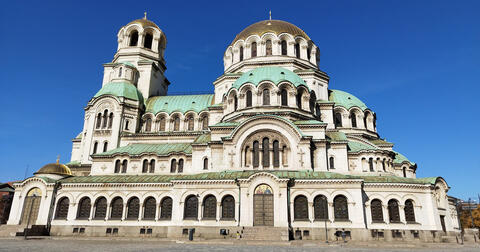
Right nearby is Sofia University “St. Kliment Ohridski”, the oldest university in Bulgaria and a landmark in its own right.
You will also find the National Library “St. St. Cyril and Methodius” next to the university, while the National Assembly building is only a short walk away.
For some fresh air, Borisova Gradina is also close. It is one of Sofia's oldest and largest parks and is popular for walking, exercise and simply taking a break from the city.
Another nearby landmark is Eagle's Bridge, or Orlov Most, which is easily recognised by the four bronze eagles on the bridge.
This station is also useful if you need to change to Metro Line M3. Leave the train at Sofia University and follow the signs through the pedestrian connection to Orlov Most metro station.
From there, Line M3 continues through areas such as Patriarch Evtimiy Square and the National Palace of Culture, usually known as NDK, before heading towards Krasno Selo, Ovcha Kupel and Gorna Banya.
Serdika
For a first-time visitor to Sofia, Serdika is probably the most practical place to get off.
The station is right in the heart of the city, and many of Sofia's central sights can be reached on foot from here.
St. Nedelya Church is just nearby, on the square of the same name. A little further on, you will find the Presidency and the Council of Ministers.
The Largo Archaeological Complex is also in this area. It offers an interesting contrast between modern Sofia and the remains of the ancient Roman city of Serdica.
Within a short walk you can also reach Banya Bashi Mosque and the Central Market Hall.
From Serdika, it is easy to continue towards Vitosha Boulevard as well. This is Sofia's best-known pedestrian street, with plenty of cafés, restaurants and shops. On a clear day, you can also enjoy a view towards Vitosha Mountain.
Serdika is not only useful for sightseeing. It is one of the city's main metro interchange points.
If you need to reach Sofia Central Railway Station or the Central Bus Station, leave the train at Serdika and follow the signs to the connected Serdika II station. From there, take Metro Line M2 in the direction of Obelya and get off at Central Railway Station.
The metro gives you direct access to the railway station. Sofia Central Bus Station is only a few minutes away on foot.
From the Central Railway Station, trains continue to destinations such as Plovdiv, Varna, Burgas and Veliko Tarnovo. National and international buses also leave from Sofia Central Bus Station — see the Balkans by public transport guide for tickets, borders and onward routes across the region.
What If You Arrive Late at Night?
Late-night arrivals require a little more planning.
Once the metro has stopped running, the number of public transport options from the airport becomes more limited.
Sofia does have night bus services, but routes and timetables may change. For that reason, it is better to check the available connection for the exact night of your arrival.
If the night transport options are inconvenient, taking an official taxi is usually the simplest solution.
Taking a Taxi Instead
Public transport is cheaper, but a taxi can make sense in certain situations.
For example, I would consider it if I arrived very late, had several heavy bags, was travelling with small children or needed to reach a hotel far from a metro station.
It may also be reasonable for a small group, since the cost can be shared between several passengers.
Under normal traffic conditions, the journey from Sofia Airport to the city centre takes roughly 20–30 minutes. The price depends on the exact destination, traffic and time of day, but a trip to central Sofia can cost approximately €8–12.
My advice is to use the official taxi desk or the designated taxi rank outside the terminal.
I would avoid accepting a ride from people who approach passengers inside the Arrivals hall and offer taxi services directly.
My Recommendation
For most travellers arriving at Terminal 2 while the metro is still running, I think Line M4 is the best choice. It is simple, inexpensive and usually the most predictable way to reach the centre.
From Terminal 1, I would normally take the free shuttle to Terminal 2 and continue by metro. Bus 84 is a perfectly reasonable alternative, especially if you would rather avoid changing between two different types of transport.
For a late-night arrival, check the available public transport before your trip. If the connections do not work well with your arrival time, an official taxi is likely to be the easiest option.
Practical Tips
For most tourists visiting Sofia for the first time, Serdika is the most convenient station for reaching the historic centre.
If you are staying near Alexander Nevsky Cathedral, the National Assembly or Borisova Gradina, Sofia University station may save you some walking.
Travellers continuing by train or intercity bus can change at Serdika and use the metro connection towards Central Railway Station.
When using a bus, allow some extra time during the morning and evening rush hours.
If your flight lands late, check the last metro departure for the day before travelling.
It is also a good idea to download an offline map of Sofia before your flight. This can be surprisingly useful if you land without mobile internet or have trouble connecting to a local network.
When changing metro lines, follow the station signs and listen to the announcements rather than relying only on memory.
And finally, for very late arrivals, check the night transport options beforehand. It is always easier to know your alternatives before you walk out of the terminal.
Arriving somewhere else in Europe? The airport transfer guide covers the same ground for nine European airports.
New route online? You'll see it on Telegram first.
Follow on TelegramRoute Details
Sofia Airport Terminal 2
0h 30m


Serdika Station
€0.80
0 hours
-
FAQ - Quick Guide
0 Comments
Sign in to write a comment and share your experience.
LoginSimilar routes
Discover the best transport routes curated by our community.

Sofia to Belgrade by bus | Experience report, tickets & route
The bus connection from Sofia to Belgrade is one of the easiest and most affordable ways to travel between the …

Getting from Belgrade Airport to the City Center by Public Transport
How to Take the Bus from Belgrade Airport to the City Center Right outside the terminal, you’ll find the bus …

Belgrade to Bar by Train
Last updated: June 2026 The Belgrade to Bar train journey is widely considered one of the most scenic routes in …

Seven Rila Lakes Hike: A Journey Through Bulgaria’s Alpine Wonderland
Why the Seven Rila Lakes Hike Is One of Bulgaria’s Top Experiences In the next lines, we will introduce you …
How to Get to Mount Musala by Public Transport
Note: Costs depend on the route and may vary. The prices shown are for guidance only. Last update: March, 2026 …
User Name
Just now--:--
€ 0,00